Updated 2004-12-01
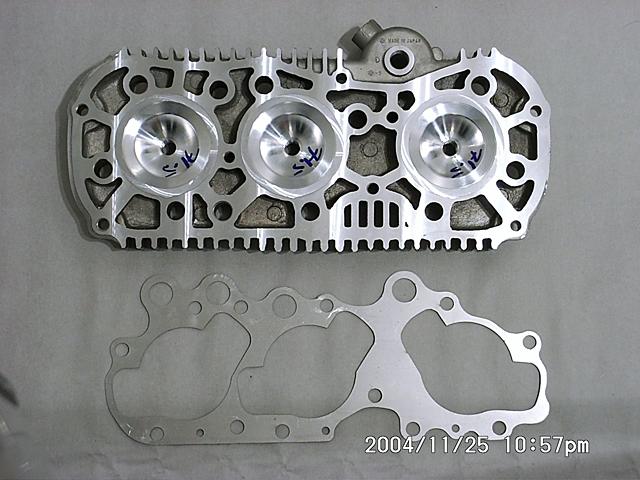
I enrolled as customer of a project where GT750 owners can send in a GT750 cylinder head for modification. The head is machined and modern engine technology "squish head billett domes" are fitted. This means that an alloy insert is NC machined to the shape of a combustion chamber according to a computer programmed shape. A corresponding cavity is machined in the cylinder head and the insert is fitted with small tolerances. An O-ring is used to seal around the spark plug opening. The insert is machined level with the cylinder head gasket surface which is also skimmed. The result is that the original combustion chambers are replaced with new ones of a different shape. This is one of three actions taken to increase engine performance. In my case I like to preserve low rev torque and still gain a few hp at the top.
The shape of the combustion chamber with the characteristic 'squish band' area are the result of computer simulations using engine design software. This combustion chamber shaoe have become commonplace today in high performance engine designs. For example with this design it should be possible to employ higher compression ratios without a predetionation problem. This head is just one component in a set of modifications for increased efficiency/power. I at least initially do not plan to do any advanced changes.
For this project I use an extra head and cylinder block, the original parts are on the shelf.
A project like this typically consists of three components
1. Modified head as the above
2. Modified port timing
A spacer is placed under the cylinder block to lift overall port timing, a corresponding amount (taking into account
head gasket thickness and obtaining proper squish clearance) is skimmed off the top of the cylinder barrell. Ports
are modified according to a recipe for performance modification (raised outlet, lowered inlet, some widening, transfer
port mods.
3. Expansion chambers are mounted.
To begin with I won't go to this level.
The total cost for obtaining the head has been as follows
Good used original GT750 cylinder head
100 dollar down payment + shipping of the head to the U.S appr 40 dollars
366 dollars final cost including return air shipping to Sweden including a 1.5mm spacer plate.
Totalt 500 dollar = 3750 Skr
I think a fair cost given the unique GT750 application and small series machining efforts.
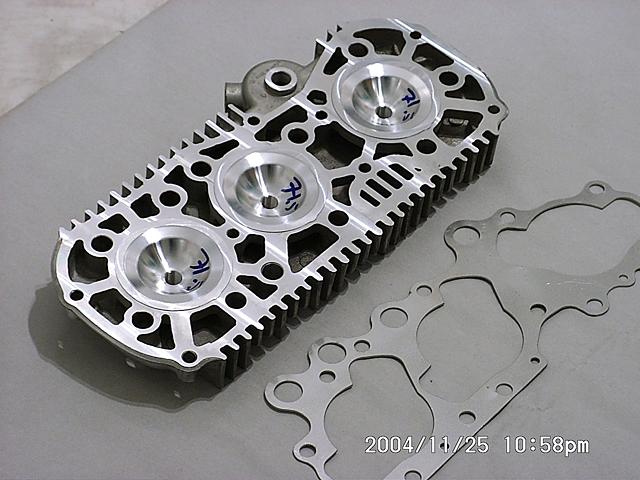
This shows the head with the inserts in place. I got a 1.5 mm aluminium spacer included as well whic is part
of a more advanced tuning recipe.
I haven't settled yet for the amount of modification. To begin with I'm happy with just looking at the parts.


The squish principle is that a very small clearance is obtained between the piston top surface and a 'band' area
around the perimeter of the combustion chamber. This has the effect of the fuel/air mixture being pressed (or 'squished')
so it flows rapidly towards the center of the combustion area. During engine build the squish clearance is measured
by placing strips of solder between piston and head and measuring the thickness of compressed wire.
Here are links to various pages where the squish head technique is used :
http://www.adaracing.com/viewitem.php?id=ya701mhdkit&maincat=watercraft
http://www.adaracing.com/viewitem.php?id=yb350hdkit&maincat=dirt
http://www.pswsracing.com/pocketbikes/hp_parts.html
http://www.chevyhiperformance.com/techarticles/94138/
Quote from such a page (not related to my particular head) :
"If you look at the combustion chamber on your head there will be an area on the outer diameter that is not angled as much as the inner part . This is where your piston comes the closest to the head . This is your squish band."
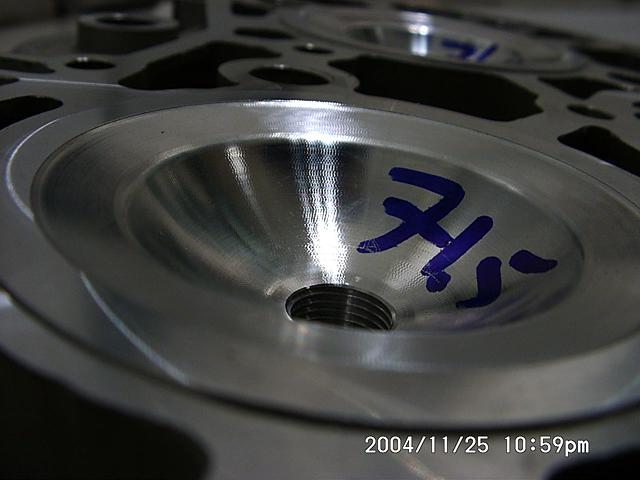
"The squish angle on the piston is measured at 5 degrees.
The squish-band on the cylinder head is machined to 10 degrees. This enables the squished gasses to diverge as
they flow towards the combustion chamber. The computer program calculates the velocity of the turbulent squished
gasses, as the piston reaches TDC. This is expressed as Maximum Squish Velocity (MSV). The MSV can be tuned to
a
rider's style and the fuel used in the bike."
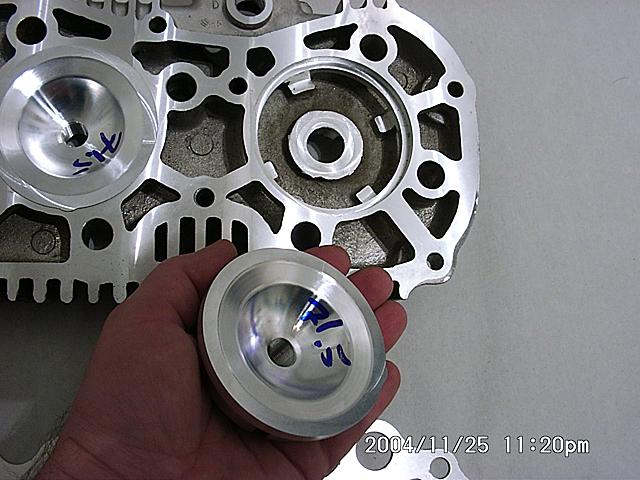
Here's how it is designed. The original combustioin chamber is machined out and a new insert machines so it fits
exactly in place of the original.
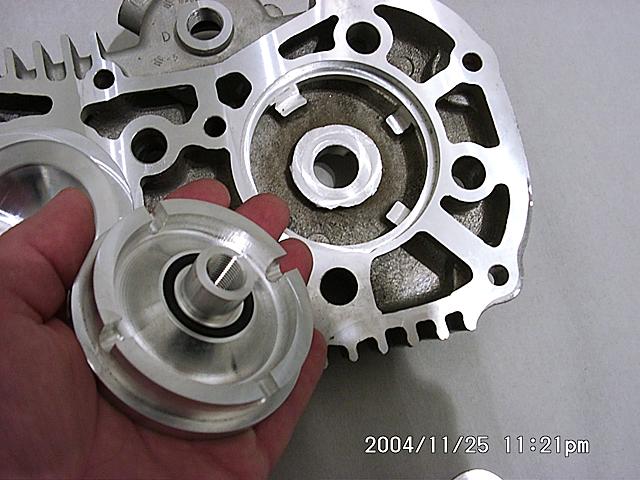
On the opposite side of the insert an O-ring will seal around the spark plug opening and prevent coolant from escaping.
The insert is held in place when the cylinder head is bolted in place against the cylinder barrel. This is a controversial mounting method which has its opponents and a subject of heated discussions in the GT750 forum. Only practical use will tell if the design is adequate or require refinement. One aspect that has been discussed is that it may be advisable to use the old type of thicker head gasket for more reliable sealing (compared to using the later style thin metal gasket) and take its thickness into account when deciding on actual cylinder barrel top surface skimming. The overall main objective to keep in mind is to end up with a proper squish band clearance (gap between piston and squish band surface at TDC).
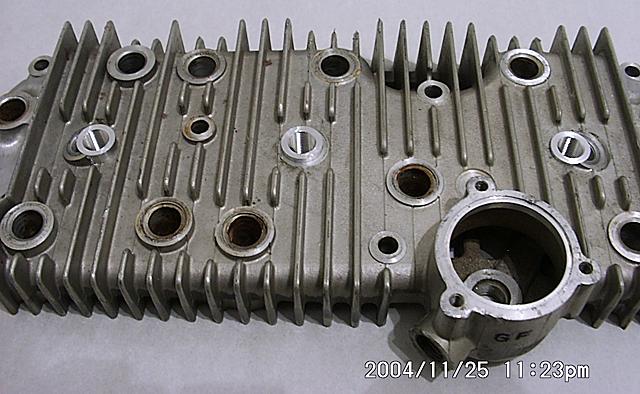
Så här ser toppen ut ovanifrån med insatserna på plats. En skillnad mot normalt är att tändstiften nu alla pekar rakt upp.
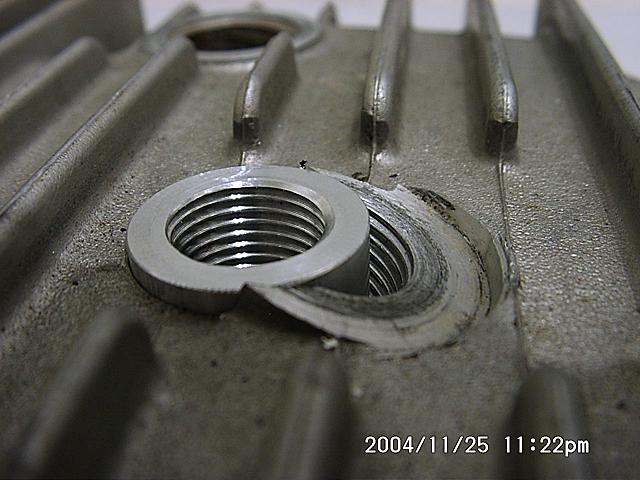
Closeup phot that shows how the insert means that the spark plugs will all point vertically. This is an issue with
the right hand cylinder where the spark plug cap will
jam against the water cooling hose. The old hole will be sealed with Permatex grey silicon paste to prevent
corrosion due to water accumulating there. The insert is sealed by the O-ring so the paste have no other function
than sealing against exterior moisture as well as a cosmethic effect.
